Choosing reliable storage equipment can influence picking speed, stock visibility, and daily warehouse safety. China’s manufacturing market offers many carton flow systems, but supplier quality varies widely. This guide examines China Top 10 Carton Flow Storage Suppliers through practical selection criteria, not marketing claims alone.
A dependable supplier should understand carton dimensions, load weights, roller pitch, shelf depth, and replenishment methods. For example, a fast-moving warehouse may need angled lanes and front-facing labels. A heavier product may require reinforced rollers and stronger frames. Product samples, technical drawings, factory photographs, and installation records can reveal more than a polished website. Small details matter.
Experience still needs verification. Buyers should request customer references, material specifications, quality-control procedures, and after-sales commitments. Factory audits can confirm production capacity, testing equipment, and packaging standards. Clear communication also matters when custom dimensions or mixed carton sizes are involved. One overlooked measurement can create repeated picking problems.
This ranking should not be treated as permanent. Supplier capabilities, certifications, prices, and delivery performance can change. That is worth remembering. Information may also come from company-provided materials, so independent checks remain necessary. A careful comparison should consider total cost, lead time, spare parts, installation support, and long-term durability.
The selected companies are discussed as potential partners for different warehouse needs. Some may suit large distribution centers, while others may serve smaller operations or custom projects. The goal is practical guidance: helping readers compare Carton Flow Storage suppliers with clearer expectations, measurable questions, and fewer costly surprises.
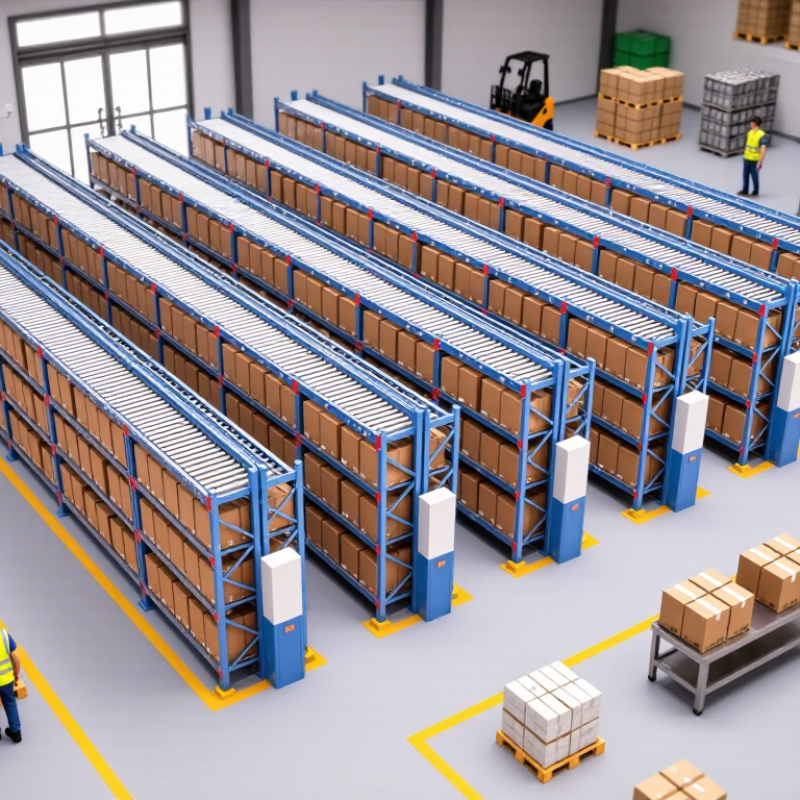
Carton flow storage is a gravity-fed picking system for cartons, totes, and small cases. Each lane uses inclined rollers or wheels. Workers load products from the rear and pick them from the front. As one carton leaves, the next carton moves forward automatically. This supports first-in, first-out rotation and keeps fast-moving items visible.
The system can reduce walking and simplify replenishment. MHI’s 2024 Annual Industry Report found that 55% of supply-chain leaders planned to increase technology investment. Carton flow is not fully automated, but it supports practical warehouse efficiency. A picker can face labeled bins, scan a location, and reach the next item without crossing the aisle. Lane width, carton weight, slope, and divider spacing require careful testing. Small mistakes create jams.
That detail matters.
Experienced warehouse teams should measure pick frequency, SKU dimensions, replenishment time, and error rates before choosing suppliers. The 2023 WERC DC Measures report emphasizes labor productivity and order accuracy as key distribution-center metrics.
However, carton flow does not solve every problem. Slow-moving products may waste valuable lane space. Heavy cartons can move too quickly. I have seen layouts appear efficient on paper but fail during peak shifts. Supplier evaluation should include load testing, spare-part access, installation support, and worker feedback. Metrics should be checked after several weeks, not only during commissioning.
China has become a major carton flow storage supplier because it combines manufacturing scale, engineering skills, and flexible production. Many factories produce rollers, frames, dividers, and guide rails in the same supply chain. This reduces waiting time and supports customized warehouse layouts.
Carton flow systems help products move by gravity toward the picking side. They are useful for cartons, totes, and small boxes in order-picking areas. Chinese suppliers often adjust lane width, roller spacing, load capacity, and working height for each project. Experienced suppliers can also provide drawings, sample testing, and installation guidance. Still, low prices alone do not prove reliable quality. That assumption needs careful review.
Tips: Ask for material specifications, load test records, and corrosion-resistance details. Check whether rollers move smoothly under real carton weights. Review welds, frame alignment, and replacement-part availability. A small trial lane can reveal problems before a full purchase. Measure your cartons carefully. Even a few millimeters can affect product flow. Discuss safety margins, packaging protection, and delivery inspections in writing. Suppliers with clear technical answers are usually easier to trust. But communication can still fail, especially when warehouse terms differ between countries. Use drawings, photos, and simple measurements to reduce mistakes.
An anonymized comparison of leading Chinese carton flow storage supplier profiles based on common manufacturing capabilities, product specifications, export readiness, and industry service coverage.
| Profile | Primary Manufacturing Region | Typical Product Focus | Common Load Capacity | Typical Roller Pitch | Surface Treatment | Customization Capability | Typical Lead Time | Export Coverage | Key Competitive Strength |
|---|---|---|---|---|---|---|---|---|---|
| 01 | East China | Gravity carton flow racks for warehouses and distribution centers | 30–100 kg per carton lane | 50–75 mm | Powder coating | Beam length, lane depth, dividers, and guide rails | 20–35 working days | Asia, Europe, North America, and the Middle East | Strong engineering support and broad warehouse-racking experience |
| 02 | South China | FIFO carton flow shelving for order-picking operations | 25–80 kg per carton lane | 50–100 mm | Powder coating or galvanized steel | Carton sizes, shelf heights, and replenishment access | 25–40 working days | Southeast Asia, Australia, Africa, and the Americas | Efficient production for mixed-size and medium-volume projects |
| 03 | Central China | Heavy-duty carton flow modules integrated with pallet racking | 50–150 kg per carton lane | 60–100 mm | Powder coating | Multi-level layouts, pallet-rack integration, and safety accessories | 30–45 working days | Europe, Central Asia, and the Middle East | Good balance between structural capacity and project flexibility |
| 04 | East China | Light-duty carton flow shelves for retail and small-item picking | 10–40 kg per carton lane | 35–60 mm | Powder coating | Adjustable shelf levels, plastic rollers, and front stops | 15–30 working days | Asia-Pacific, Europe, and Latin America | Competitive pricing for standardized warehouse applications |
| 05 | Southwest China | Carton flow systems for manufacturing plants and spare-parts storage | 20–100 kg per carton lane | 50–75 mm | Powder coating | Workstation links, kitting areas, and line-side replenishment | 25–40 working days | Domestic China and selected Asian markets | Practical solutions for lean manufacturing and line-side logistics |
| 06 | North China | Industrial carton flow racks for automotive and machinery components | 40–120 kg per carton lane | 60–100 mm | Powder coating or galvanized steel | Reinforced frames, steel rollers, and high-cycle components | 30–50 working days | Central Asia, Eastern Europe, and domestic markets | Suitable for demanding industrial environments and frequent replenishment |
| 07 | East China | Modular carton flow systems for e-commerce fulfillment centers | 15–75 kg per carton lane | 35–75 mm | Powder coating | High-density layouts, pick-to-light preparation, and modular expansion | 20–35 working days | North America, Europe, Australia, and Southeast Asia | Fast adaptation to changing SKU counts and order profiles |
| 08 | South China | Stainless and corrosion-resistant carton flow components | 20–80 kg per carton lane | 50–75 mm | Galvanized or stainless steel | Food-grade layouts, washdown-area components, and special rollers | 30–50 working days | Asia-Pacific, the Middle East, and selected European markets | Improved corrosion resistance for hygienic or humid environments |
| 09 | Central China | Budget-oriented carton flow shelving for small and medium warehouses | 20–60 kg per carton lane | 50–100 mm | Powder coating | Standard modules, basic dividers, and adjustable supports | 15–30 working days | Asia, Africa, Latin America, and domestic China | Short production cycles and accessible project pricing |
| 10 | East China | Engineered carton flow solutions for automated and semi-automated warehouses | 30–120 kg per carton lane | 35–75 mm | Powder coating or galvanized steel | Conveyor interfaces, sensor mounting, and warehouse-system integration | 35–60 working days | Europe, North America, Japan, South Korea, and Southeast Asia | Higher integration potential for sophisticated fulfillment projects |
Note: Capacity, roller pitch, lead time, and export coverage are representative industry ranges rather than company-specific claims. Final specifications should be confirmed through load calculations, carton dimensions, operating conditions, and project drawings.
Evaluating China’s top 10 carton flow storage suppliers requires more than comparing catalog prices. The 2024 MHI Annual Industry Report reports that 43% of surveyed supply-chain leaders use robotics and automation. This signals a practical need for compatible, scalable storage equipment. Ask each supplier for load ratings, roller spacing, frame thickness, FIFO performance, and replacement-part availability. Test cartons with your actual product dimensions.
Look closely at engineering evidence. Request layout drawings, load calculations, factory quality records, and recent project references. TÜV Rheinland’s 2024 global study on industrial quality highlights traceability and process control as major trust factors. Therefore, review inspection records, welding standards, coating thickness, and batch identification. Small details matter. A weak coating may fail in humid warehouses.
Compare total cost, not only unit price. Include packaging, delivery, installation, maintenance, and future expansion. Supplier response time also reveals operating discipline. I would score technical fit at 35%, quality control at 25%, lifecycle cost at 20%, and service at 20%. This weighting is imperfect, but it prevents low prices from dominating the decision. Be cautious with impressive factory photos. Independent testing is stronger evidence.
Leading Chinese carton flow storage suppliers typically offer gravity roller lanes, wheel-bed tracks, carton live racks, dividers, and replenishment carts. Many also provide FIFO or FEFO layouts, adjustable pitch, safety guards, labels, and basic warehouse management interfaces. These products support fast picking from shallow cartons. They suit ecommerce fulfillment, food and beverage, consumer goods, automotive parts, electronics, and temperature-controlled distribution.
MHI’s 2024 Annual Industry Report found that 55% of supply chain leaders planned to increase technology investment. This supports demand for flexible flow storage, especially where order volumes change quickly. The 2024 LogisticsIQ warehouse automation outlook also forecasts strong double-digit market growth through 2027.
However, carton flow is not automatically the best solution. Heavy cartons may deform lanes, while poor replenishment discipline creates empty pick faces. Supplier selection should include load testing, wheel durability, corrosion resistance, and local service capacity.
Tips:
Request a sample bay before purchasing. Test real cartons, not ideal boxes. Check replenishment time, noise, cleaning access, and spare-part availability. A lower price can hide weaker rollers or inaccurate dimensions. One overlooked detail is aisle width. It affects both labor speed and equipment safety. Suppliers should provide drawings, load calculations, installation guidance, and inspection records. These details feel minor, but they often decide whether a rack performs well after six months.
When selecting a carton flow storage supplier in China, start with your product and picking process. A reliable supplier should ask about carton dimensions, weight, turnover rate, and replenishment frequency. If the discussion begins with price alone, stay cautious. Experienced engineers calculate roller pitch and frame loading from real carton samples. Request a layout drawing before confirming quantities. Small details matter.
A factory visit, or a live video inspection, can reveal production discipline. Check welding quality, surface treatment, roller movement, and component storage. Ask for material traceability, load-testing records, inspection procedures, and installation guidance. Suppliers should explain tolerances clearly, not hide behind general claims. Do not accept vague promises. Confirm spare-part availability and response times for technical support.
Compare total cost, not only the initial quotation. Include packaging, delivery, installation, training, and future adjustments. Ask for references from warehouses with similar carton sizes and picking speeds. A small pilot section can expose poor roller alignment before a full purchase. I have seen low quotes become expensive after repeated adjustments. That mistake is easy to make. Review drawings with warehouse operators, because practical feedback may challenge an engineer’s assumptions. A dependable supplier welcomes these questions and records every agreed specification.
It is a gravity-fed picking system for cartons, totes, and small cases. Inclined rollers move products toward the picking side.
Workers load products from the rear. Pickers remove items from the front. The next carton moves forward automatically.
Yes. It naturally supports first-in, first-out rotation. This helps keep older stock available for picking.
It suits fast-moving items with regular carton sizes. Common examples include food, electronics, consumer goods, and automotive parts.
They should review carton dimensions, weight, turnover rate, and replenishment frequency. Real product samples are much better than assumptions.
Heavy cartons may move too quickly or deform lanes. Poor alignment can create jams. Small mistakes hurt.
Request a sample bay or small pilot section. Test real cartons, roller movement, noise, cleaning access, and replenishment speed.
Check load tests, welding quality, surface treatment, spare parts, installation support, and technical response times. Do not trust vague promises.
Not always. Lower prices may hide weak rollers, inaccurate dimensions, or limited support. Total cost matters more.
Measure picking speed, order accuracy, replenishment time, and empty pick faces after several weeks. Paper layouts can be misleading.
This guide explores Carton Flow Storage, a dynamic shelving solution designed to improve order picking, product rotation, and warehouse space utilization. It explains how cartons move along inclined roller tracks from the loading side to the picking side, allowing operators to access goods efficiently while supporting first-in, first-out inventory management. The article also examines why China has become a major supplier, highlighting its broad manufacturing capabilities, flexible customization, competitive production costs, and ability to serve diverse logistics needs.
It further presents practical criteria for evaluating China’s top suppliers, including product quality, structural durability, load capacity, system design, safety features, customization options, delivery reliability, and after-sales support. Readers will learn about common Carton Flow Storage products and the industries that use them, such as retail, e-commerce, manufacturing, food distribution, and spare-parts management. Finally, the guide offers a clear framework for selecting a suitable supplier based on warehouse conditions, operational goals, budget, installation requirements, and long-term service capabilities.

Fangjiu Rack