Choosing the best Boltless Systems in 2026 requires more than comparing prices, shelf levels, or shiny product photographs. Storage decisions now affect labor efficiency, safety, inventory accuracy, and future expansion. The MHI 2024 Annual Industry Report identifies artificial intelligence as a rapidly growing supply-chain technology, with 55% of respondents expecting significant adoption within five years. That shift matters. A shelving system should support clearer picking routes, barcode scanning, and changing stock profiles.
Look closely at the physical details. Can one worker assemble the frame without welding equipment? Do the beams lock firmly when a rubber mallet is used? Are the shelves suitable for cartons, tools, archive boxes, or irregular loads? A narrow aisle may save floor space, yet it can slow trolley movement. Adjustable levels may increase capacity, but frequent changes can weaken discipline if load limits are ignored. Small details matter.
Safety cannot be an afterthought. OSHA warehousing guidance emphasizes stable storage, clear aisles, and protection from falling materials. Local requirements may differ, so buyers should verify them with qualified professionals. Manufacturer load tables also deserve careful review. They should identify bay width, beam spacing, deck type, and permissible weight. Marketing language is not engineering evidence.
No system is perfect. I have seen attractive installations become inconvenient after product sizes changed. That lesson is easy to miss. The strongest choice balances modularity, tested capacity, corrosion resistance, installation quality, and total ownership cost. This guide examines those factors for 2026, while acknowledging that the cheapest starting price may create the most expensive constraints later.
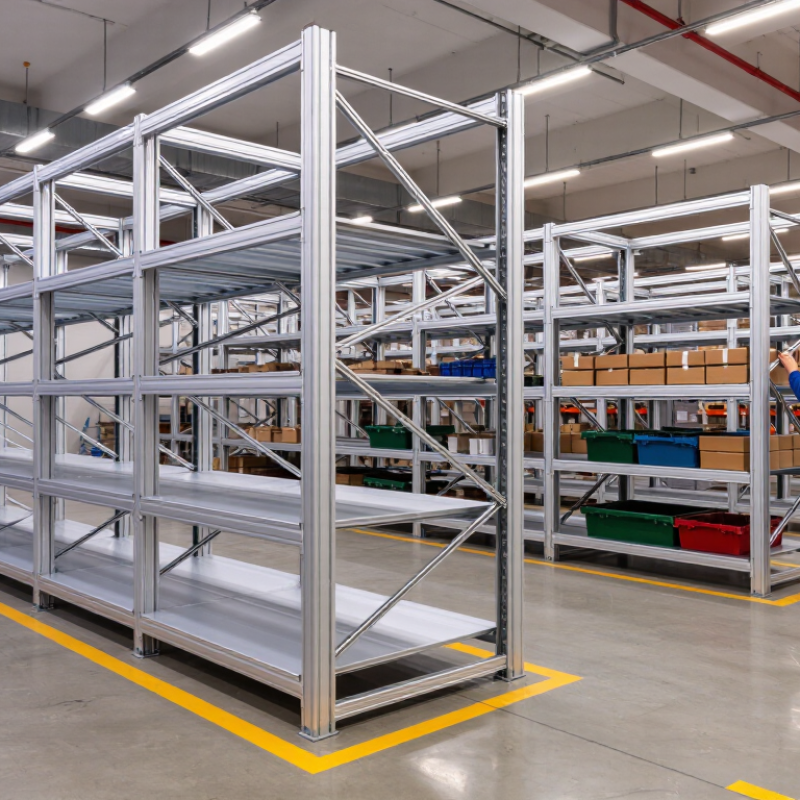
Boltless systems are storage structures assembled without traditional nuts and bolts. Their frames use slots, rivets, clips, or locking tabs instead. Uprights carry the load, while horizontal beams support shelves or decking. A rubber mallet may help during installation. No complex hardware is usually required.
The main type is rivet shelving. Its beams connect to uprights through riveted connectors and suit boxes, tools, and archive materials. Clip-in shelving uses shaped clips that fit into vertical slots. It allows faster shelf adjustment, especially when storage heights change often.
Keyhole or teardrop systems are common in heavier-duty racking. Their beam connectors drop into shaped openings and lock under load. Wire boltless units provide airflow and visibility for workshops, stockrooms, and equipment areas.
From practical installation experience, the connection design matters more than the “boltless” label. Check the rated capacity for each shelf, not only the entire bay. Inspect upright feet, beam locks, and floor contact before loading. Uneven concrete can make a stable-looking frame unsafe. Many systems are advertised as tool-free, yet a mallet or level remains useful. That detail is easy to overlook. Assembly quality also depends on following the manufacturer’s load tables and spacing rules. I would not treat a boltless frame as automatically flexible or indestructible. Shelves can bend, clips can seat poorly, and overloaded corners may fail first.
Load capacity should guide every boltless system decision. The 2024 MHI Annual Industry Report found that 83% of supply-chain professionals expect operating challenges to increase. That pressure makes accurate capacity planning essential.
Measure the heaviest carton, not the average one. Add its contents, container weight, and a practical safety margin. A shelf rated for 300 kilograms may fail your needs when loads shift during picking.
Dimensions must match the items and the room. Record ceiling height, aisle width, door clearance, and sprinkler space before ordering. The U.S. Occupational Safety and Health Administration requires stored materials to remain stable and secure under 29 CFR 1910.176(b).
Measure twice. I once underestimated handle clearance by only three centimeters, which made a neat layout awkward to use. Small errors become daily frustrations.
Storage requirements also change with inventory movement. The 2024 WERC DC Measures report emphasizes measurable warehouse performance, including picking and order-cycle efficiency.
Choose deeper shelves for reserve stock, but avoid burying frequently accessed cartons. Leave usable hand clearance between levels. Adjustable beams help, though too many unused positions waste vertical space.
Review seasonal demand, product weight distribution, and future equipment before fixing the layout. A system that fits today may restrict tomorrow.
A dependable boltless system uses interlocking beams, clear instructions, and parts that seat firmly with a rubber mallet. In my workshop, the first unit took longer than expected because one upright was slightly uneven. That small mistake caused a tilted shelf. Check the floor, sort every component, and confirm each connection before adding weight. A stable frame matters more than fast assembly.
Assembly should feel controlled, not effortless. Adjustability determines whether the system remains useful after your storage needs change. Look for shelf levels that move in small, practical increments. A 50-millimeter adjustment can accommodate boxes, tools, or taller containers without wasting vertical space.
Test the locking points by hand. They should engage fully without excessive force. Load ratings should be visible and based on evenly distributed weight, not optimistic estimates. This detail is easy to overlook.
Space efficiency involves more than narrow dimensions. Measure doorways, wall clearance, and access paths before choosing a frame. Deeper shelves hold more, but they may hide smaller items at the back. I prefer adjustable layouts with open fronts, especially in compact rooms.
Leave enough clearance for safe handling and cleaning. A tighter arrangement may look efficient, yet it can become frustrating in daily use. My early layout was too dense. That was a useful lesson.
How to Choose the Best Boltless Systems in 2026?
Safety should guide every boltless-system decision. The U.S. Bureau of Labor Statistics recorded 865 fatal workplace falls, slips, and trips in 2022. A stable frame matters. Choose systems with positive-lock beams, visible load ratings, diagonal bracing, and adjustable feet. Check floor capacity before installation. Keep aisles clear and prevent uneven loading. Boltless does not mean risk-free.
Durability depends on steel thickness, coating quality, and daily handling. NFPA’s Warehouse Fires report estimated 1,210 warehouse fires annually from 2009 to 2013, causing about $155 million in direct property damage. That history supports careful spacing and controlled storage. Inspect painted surfaces for chips, rust, and impact marks. In damp rooms, galvanized finishes may offer better resistance, but coating alone cannot fix poor ventilation.
Maintenance should be simple enough for busy staff. Use a written inspection sheet. Record bent uprights, loose connectors, overloaded shelves, and damaged decking. Replace questionable parts promptly. Do not improvise repairs. ANSI MH16.1 provides useful principles for rated steel storage equipment, including load information and safe use. I still distrust a perfectly clean checklist. Real warehouses are messier. Dust hides cracks, and rushed restocking changes loading patterns. Review the system after relocation, expansion, or repeated impacts. Safety improves when workers can report small defects without delay.
Evaluate Safety, Durability, and Maintenance Features
Scores use a 1–5 evaluation scale, where 5 represents stronger performance. Safety considers load stability, locking security, and resistance to accidental disengagement. Durability considers material strength, corrosion resistance, and repeated-use performance. Maintenance considers ease of assembly, adjustability, inspection, and replacement of components.
How to Choose the Best Boltless Systems in 2026?
Balance Total Cost, Expandability, and Long-Term Value
Choosing a boltless system requires more than comparing purchase prices. Check its load rating, shelf depth, steel thickness, and adjustment method. A cheap unit may need replacement after repeated moves. Measure your storage area carefully, including door clearance and ceiling height. In real installations, small measurement errors create expensive problems.
Think about future changes. Adjustable levels support changing inventory, tools, or household needs. Select a system that accepts extra shelves and extensions without forcing a complete rebuild. I once saw a storage plan fail because the original shelves fit perfectly, but later equipment required greater clearance. The lesson was simple. Leave room to adapt.
Tips: Calculate the total cost over five years. Include delivery, assembly time, accessories, and possible replacement parts. Test one section before ordering many units. Check whether the frame remains stable when shelves are unevenly loaded. Also inspect the finish if the system will sit in a humid garage. A spreadsheet helps, but it can miss daily inconvenience. Ask whether workers can adjust shelves safely and quickly. Long-term value often comes from fewer disruptions, not the lowest invoice.
| System Category | Typical Application | Typical Bay Size | Load per Level | Starter-Bay Cost | Add-On Bay Cost | Assembly Time | Expandability | Expected Service Life | Best Fit | Value Score |
|---|---|---|---|---|---|---|---|---|---|---|
| Light-Duty Clip-In Shelving | Small parts, cartons, tools, archives, and retail backroom stock | 900 × 450 × 1800 mm | 100–250 kg | $150–$280 | $110–$220 | 20–40 min | Easy to extend horizontally; limited suitability for heavy loads | 8–12 years | Low-volume storage with frequent layout changes | 7.4 |
| Medium-Duty Rivet Shelving | General warehouse inventory, bins, packaged goods, and maintenance stock | 1200 × 600 × 2000 mm | 250–500 kg | $220–$450 | $160–$350 | 25–50 min | Strong modularity; shelves can usually be repositioned without tools | 10–15 years | Most mixed-use warehouses and workshops | 8.6 |
| Heavy-Duty Rivet-Beam Shelving | Dense cartons, machinery parts, industrial components, and bulkier stock | 1800 × 900 × 2400 mm | 500–900 kg | $450–$850 | $320–$700 | 40–75 min | Highly expandable, but requires stronger floors and more careful configuration | 12–20 years | High-load storage where future capacity growth is likely | 8.8 |
| Long-Span Boltless Shelving | Long cartons, furniture components, fabric rolls, and irregular inventory | 1800 × 600 × 2000 mm | 300–700 kg | $380–$750 | $280–$620 | 35–65 min | Excellent for wide bays; less efficient when narrow picking access is required | 10–18 years | Oversized products and long-span storage zones | 8.1 |
| Adjustable Multi-Level Platform | High-density stockrooms, archives, e-commerce picking, and parts storage | Custom; commonly 1800 × 600 × 2400–3600 mm | 250–600 kg | $900–$1,800 | $650–$1,450 | 2–5 hours | Very high capacity growth through additional levels and walkways | 15–25 years | Facilities where floor space is more expensive than labor | 8.3 |
| Corrosion-Resistant Boltless Shelving | Humid warehouses, food-adjacent areas, clean utility rooms, and light industrial use | 900–1200 × 450–600 × 1800–2000 mm | 150–450 kg | $300–$700 | $230–$560 | 25–55 min | Moderate to high; component compatibility should be checked before expansion | 10–20 years | Locations where moisture resistance reduces replacement costs | 8.0 |
Measure the heaviest carton, including its contents and container. Add a practical safety margin. Do not rely on average weight. Loads can shift during picking. A 300-kilogram rating may still be insufficient. Review your estimate regularly.
Record ceiling height, aisle width, door clearance, and sprinkler space. Measure wall gaps and access paths too. Measure twice. Small errors matter.
Leave enough hand clearance between shelf levels. Keep aisles open for safe handling and cleaning. Deep shelves may hide small cartons. A tight layout can become frustrating.
Use interlocking beams, firm connectors, and clear instructions. Sort every component before assembly. Check the floor for uneven areas. Seat each connection fully with a rubber mallet. Fast assembly is not the main goal.
Adjustable levels help accommodate cartons, tools, and taller containers. Small adjustments can prevent wasted vertical space. Test each locking point by hand. It should engage fully without excessive force.
Choose positive-lock beams, visible load ratings, diagonal bracing, and adjustable feet. Check floor capacity before installation. Keep aisles clear. Distribute weight evenly. Boltless does not mean risk-free.
Look for chipped paint, rust, bent uprights, impact marks, and damaged decking. Damp rooms may need corrosion-resistant finishes. Good coating cannot solve poor ventilation. Real storage areas are rarely spotless.
Use a written inspection sheet for defects and overloaded shelves. Replace questionable parts promptly. Do not improvise repairs. Review the system after relocation, expansion, or repeated impacts. I once trusted a clean checklist too much. Dust can hide cracks.
Choosing the best Boltless Systems in 2026 begins with understanding their structure and main types, such as shelving, rack-based storage, and modular work platforms. The right option depends on the items you need to store, their weight, size, and how frequently they must be accessed. Carefully check load capacity, shelf dimensions, ceiling height, and available floor space to ensure the system fits both current and future requirements.
A strong Boltless Systems solution should offer fast assembly, flexible height adjustment, and efficient use of space without requiring specialized tools. Safety features, stable construction, corrosion resistance, and easy maintenance are also essential for reliable long-term use. Finally, compare the total cost rather than only the purchase price, including installation, accessories, upkeep, and future expansion. A system that can be reconfigured or extended as your needs change will usually provide better value and greater storage efficiency over time.

Fangjiu Rack